The 40% Problem: How Non-Addressable Traffic Is Destroying Publisher Revenue
40% of digital traffic is now non-addressable, eroding publisher CPMs and programmatic demand. Learn how identity resolution restores addressability—without cookies.
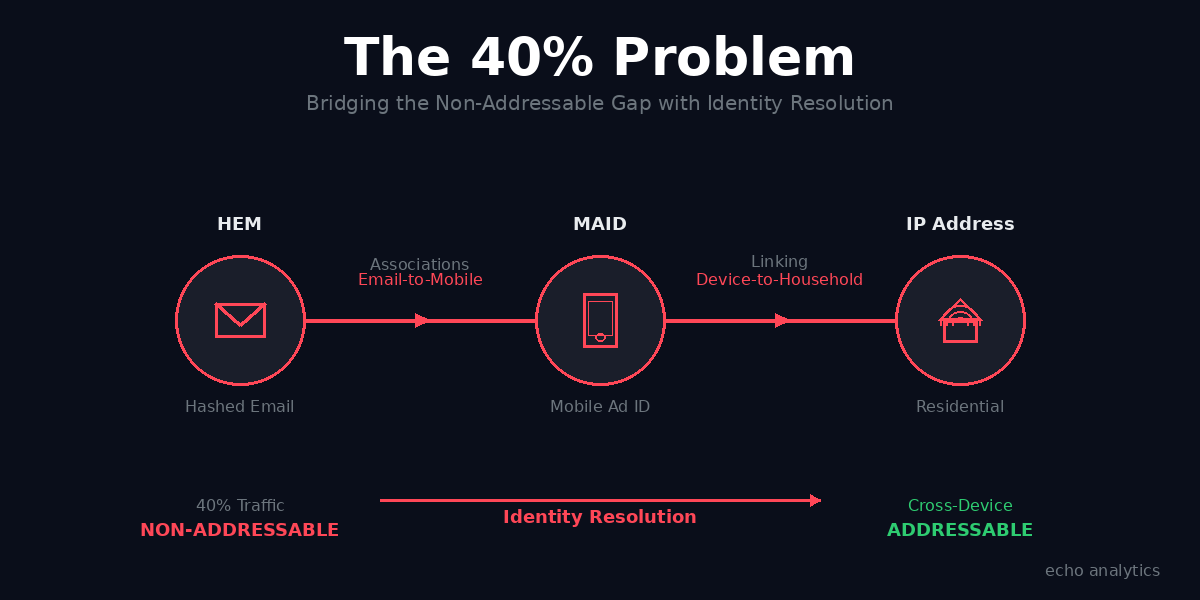
Forty percent of digital traffic is now non-addressable. Not contextual, not measurable by interest, not targetable beyond basic demographics. Simply invisible to the identity infrastructure that programmatic advertising depends on. For publishers, this isn't a privacy compliance story or a technical curiosity. It's a revenue crisis. Every impression that cannot be tied to an identifier loses value, sometimes by half or more compared to addressable inventory. When nearly half your traffic falls into this category, the math becomes brutal.
The collapse happened gradually, then suddenly. Third-party cookies disappeared from Safari in 2020, from Firefox shortly after, and Chrome's deprecation timeline keeps extending but the direction is clear. What replaced them? Mostly nothing. Publishers were told contextual targeting would fill the gap, that attention metrics would compensate, that first-party data strategies would save the day. Some of these solutions help at the margins. None restore the foundational capability that cookies provided: connecting a person's behavior across sessions, devices, and environments so that advertisers can target effectively and measure accurately.
The market needs infrastructure that reconnects fragmented digital identities without relying on deprecated browser signals. This infrastructure exists. It works differently than cookies, operates within privacy regulations, and delivers the cross-channel connections that restore addressability. But understanding the solution requires first understanding what addressability actually means and why its absence breaks publisher economics.
What "Addressable" Actually Means
Addressability is not the same as reach. A publisher might reach ten million monthly visitors, but if only six million can be identified in ways that enable targeting and measurement, the addressable audience is six million. The other four million generate impressions that programmatic buyers cannot incorporate into frequency-capped campaigns, cannot attribute to conversion events, and cannot value accurately. These impressions still sell, but often at contextual rates that reflect their limited utility.
The difference matters because digital advertising economics depend on identity. A display impression shown to someone who recently searched for "running shoes" commands a premium because the advertiser knows this person is in-market. An impression shown on a running magazine website might reach a running enthusiast, but without identity confirmation, the advertiser pays contextual rates that price in uncertainty. The gap between these rates can exceed 50%, and it compounds across millions of impressions daily.
Cookies solved this through persistent browser identifiers that connected behavior across websites. When a user visited a running website, then searched for shoes, then returned to a news site, the cookie chain let advertisers recognize this person and serve relevant ads. The system had privacy problems that justified its retirement, but it provided addressability that the market built business models around. When cookies disappeared, that addressability vanished for huge swaths of inventory.
The 40% Revenue Gap
Non-addressable traffic comes from multiple sources now. Safari and Firefox users browse without third-party cookies. Mobile app traffic often lacks persistent identifiers as Apple and Google tighten privacy controls. Connected TV inventory frequently activates on household IP addresses that don't connect to individual identity graphs. Visitors who clear cookies regularly or browse in private modes become unrecognizable between sessions.
Each source of non-addressable traffic creates specific publisher pain. Safari traffic cannot be frequency capped across campaigns, leading to over-exposure that wastes buyer budgets and reduces effectiveness. Mobile app inventory cannot be linked to web behavior, preventing attribution and making it harder to prove ROI. CTV inventory cannot be targeted below the household level without identity connections to devices within those homes.
The revenue impact scales with inventory mix. Publishers with high Safari traffic saw CPMs decline by 30% or more on that inventory compared to addressable Chrome traffic. Mobile-first publishers face even steeper challenges as app identifiers become less reliable. The aggregated effect pushes overall yield down, forces reliance on direct-sold campaigns, and makes programmatic demand less competitive.
Buyers feel the constraint too. Media agencies planning cross-channel campaigns cannot reach the same audience across mobile, desktop, and CTV without identity connections spanning those environments. Attribution becomes guesswork when impression delivery cannot be tied to conversion events through identity linking. Frequency management fails when the same person appears as three different anonymous users across devices. These limitations push programmatic spend toward walled gardens that maintain identity infrastructure internally, draining open internet budgets.
Why Legacy Solutions Are Failing
Third-party cookies are not coming back. Browser vendors have stated this repeatedly, and their commitment stems from genuine privacy concerns that matter to users. Device fingerprinting, the technique that tries to identify users through browser configuration details, gets blocked more aggressively each year. Apple and Mozilla consider it privacy circumvention and actively break fingerprinting attempts. Google's Privacy Sandbox proposals might provide limited targeting capabilities, but not the cross-site identity persistence that cookies enabled.
Contextual targeting has improved significantly, using AI to understand page content and match ads to relevant environments. This approach works for brand campaigns seeking appropriate environments rather than specific audiences. It does not solve attribution, cannot manage frequency across sites, and prices in the uncertainty of reaching users without confirmed intent signals. Publishers benefit from contextual fill, but it does not restore addressability or the premium CPMs that identity-informed targeting commands.
First-party data strategies sound promising until publishers examine what first-party data they actually collect. Most publishers lack authenticated relationships with the majority of their audience. News sites might have subscriber data covering 5% of their traffic. The other 95% browses anonymously, leaving no first-party identifier behind. Email collection helps but does not solve the cross-device problem or enable targeting on third-party inventory where that email was not provided.
The gap in the market is identity infrastructure that works without browser cookies, respects privacy requirements, and connects identifiers across the digital environments where audiences actually move. This infrastructure cannot rely on deprecated signals or privacy-circumventing techniques. It must instead use observed connections between identifiers that people actively use: email addresses, mobile advertising IDs, and household IP addresses.
How Identity Connections Restore Addressability
Identity resolution works by linking identifiers that belong to the same person or household through observed co-occurrence patterns and behavioral signals. When an email address and a mobile advertising ID appear together repeatedly in privacy-compliant data sources, this observed pattern creates a connection. When mobile devices consistently connect to the same household IP address during nighttime hours, this pattern establishes a household relationship.
These connections are not guesses or probability scores. They reflect observed behavior captured through SDK integrations, app interactions, and network-level signals that people generate through normal device use. The methodology differs fundamentally from cookie-based identity, which relied on browser storage that could be deleted or blocked. Instead, the connections link identifiers that exist outside the browser layer: hashed email addresses, mobile advertising IDs like IDFAs and GAIDs, and IP addresses observed through normal internet connectivity.
Email-to-mobile connections let publishers activate email lists across mobile inventory where those emails were never provided. A publisher with 100,000 newsletter subscribers can now reach those same people on mobile apps, in mobile games, or on other publishers' mobile inventory by matching hashed emails to mobile advertising IDs. This expands addressable reach without requiring authentication at every touchpoint, restoring targeting capability that cookie loss eliminated.
Household-to-device connections solve the CTV targeting problem by identifying which mobile devices share the same residential IP as connected televisions. When a programmatic buyer targets a CTV campaign, they receive household IPs. Without additional identity connections, these IPs cannot be extended to mobile retargeting, cannot be incorporated into cross-screen attribution, and cannot be refined below household-level granularity. Identity feeds that link residential IPs to mobile advertising IDs enable all three capabilities, dramatically improving CTV inventory value.
The privacy framework matters as much as the technical methodology. Compliant identity resolution operates on aggregated, privacy-screened data that never exposes individual movements or personal information. Connections are built from behavioral patterns observed across large panels, not from tracking individual users. Hashing techniques ensure email addresses remain protected. Geographic aggregation prevents precise location exposure. The infrastructure delivers addressability while meeting GDPR requirements and respecting user privacy expectations.
Business Outcomes for Publishers and Platforms
Publishers implementing identity resolution infrastructure report match rate improvements of 15 to 25 percent within weeks of integration. Match rate measures what percentage of impressions can be connected to identity graph entries that enable targeting. Higher match rates mean more inventory becomes addressable, which increases demand and lifts CPMs toward levels that addressable inventory commands.
The demand impact compounds beyond simple match rate math. Programmatic buyers return to inventory they previously avoided because targeting and attribution now work reliably. DSPs that dropped Safari traffic from their bidding pools re-engage when identity connections restore frequency management and measurement. Agencies planning cross-channel campaigns include publishers in their plans when household-to-device connections enable CTV-to-mobile attribution.
Attribution restoration might deliver the highest strategic value. Publishers can now demonstrate campaign effectiveness through closed-loop measurement that connects impression delivery to conversion events. When a retail advertiser runs a campaign, identity connections let the publisher prove which exposed devices subsequently visited store locations. This measurement capability, impossible with contextual targeting alone, changes the conversation with advertisers from "we delivered impressions" to "we delivered measurable outcomes."
The infrastructure investment pays forward as the market continues evolving. Browsers will restrict more signals, platforms will tighten privacy controls further, and regulatory requirements will expand. Publishers building on identity resolution infrastructure today position themselves to adapt as these changes accelerate. The alternative is watching addressable inventory shrink further while competitors who invested earlier capture growing shares of programmatic demand.
What to Look For in Identity Infrastructure
Coverage breadth separates infrastructure-grade solutions from regional point products. Publishers serving international audiences need identity connections that work across markets with consistent quality. A solution that covers the US and EU but fails in APAC or LatAm forces publishers to cobble together multiple vendors, normalize different schemas, and manage inconsistent quality. Infrastructure-scale providers operate in 150-plus countries with standardized data outputs that simplify integration and reporting.
Refresh cadence determines how quickly identity connections adapt to device changes and user behavior shifts. Monthly updates provide sufficient freshness for most use cases, while weekly updates serve publishers with rapidly changing audience dynamics. Stale connections from quarterly or annual updates reduce addressability as mobile advertising IDs reset, email addresses change, and household networks shift. The cadence should match your inventory velocity.
Privacy compliance cannot be an afterthought or regional add-on. The infrastructure must be built on GDPR-first principles that extend globally, not adapted reluctantly to meet minimum requirements. Look for providers who can explain their methodology in detail: how they collect signals, where they apply aggregation, how they prevent re-identification, and which technical controls ensure compliance. Vague privacy claims or US-only compliance frameworks signal risk.
Integration simplicity determines time to value. The best infrastructure plugs directly into existing DSPs, CDPs, and data warehouses without requiring platform changes or custom development. Batch file delivery to cloud storage buckets works for most publishers. API integration serves platforms needing real-time access. The key is standards-based delivery formats (Parquet, CSV, JSON) that your existing systems already consume. Complex proprietary integrations delay deployment and create maintenance burdens.
The Infrastructure Decision
Non-addressable traffic is not a temporary problem that better contextual algorithms will solve. It reflects a structural shift in how digital identity works after cookies. Publishers must either invest in identity infrastructure that restores addressability or accept steadily declining monetization as programmatic buyers shift spend to environments where targeting and measurement still function reliably.
The 40% problem gets worse before it gets better. More browser restrictions are coming, not fewer. Platform privacy controls will tighten further in response to regulatory pressure and user expectations. Publishers who delay identity infrastructure investment will find themselves competing with diminishing advantages against competitors who acted earlier. The revenue gap compounds quarterly as addressable inventory becomes scarcer and commands higher premiums.
Identity resolution infrastructure exists, works at scale, operates within privacy frameworks, and integrates into existing publishing stacks. The question is not whether publishers need this infrastructure. The question is how much revenue they are willing to lose before making the investment.


Frequently Asked Questions
What is non-addressable traffic?
Non-addressable traffic consists of impressions that cannot be connected to identifiers enabling targeting, frequency management, or attribution. This includes Safari users without third-party cookies, mobile app traffic lacking persistent IDs, and CTV inventory without household-to-device connections.
Why does addressability matter more than reach?
Reach measures total audience size. Addressability measures what portion can be targeted and measured effectively. Programmatic buyers pay premiums for addressable inventory because it enables precision targeting, frequency control, and attribution. Non-addressable inventory often sells at contextual rates 30-50% lower.
How does identity resolution improve match rates?
Identity resolution links email addresses, mobile advertising IDs, and IP addresses through observed behavioral patterns. These connections expand the number of impressions that can be tied to identity graph entries, increasing the percentage of inventory that qualifies as addressable.
Can identity resolution work without cookies?
Yes. Identity resolution uses observed connections between email addresses, mobile advertising IDs, and household IP addresses. These identifiers exist outside the browser layer and are not affected by cookie deprecation. The methodology relies on behavioral patterns captured through SDK integrations and network-level signals.
Is identity resolution GDPR compliant?
Properly implemented identity resolution operates within GDPR requirements. Privacy-compliant approaches use hashed emails, aggregated behavioral patterns, and geographic clustering that prevent individual identification. The methodology delivers addressability while respecting privacy regulations when built on GDPR-first principles.