Why your stable match rates might be hiding a performance crisis. Discover how behavior-validated household IPs create more reliable targeting
Why high match rates can still lead to poor performance—and how unstable IP data is the hidden culprit.
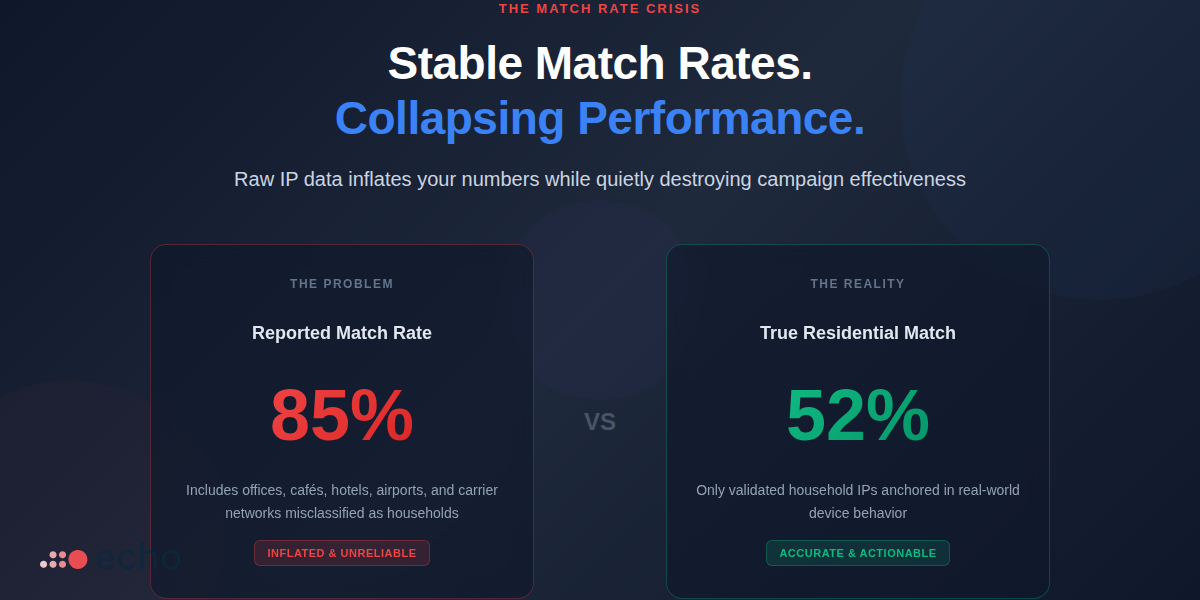
Match rates are quietly killing performance — and raw IP data is making it worse
The advertising ecosystem is under pressure. Costs are rising, signal fidelity is fading, and targeting effectiveness continues to erode. Much of the discourse has focused on the loss of identifiers or tightening privacy regulations. These are valid concerns—but they obscure a deeper, structural issue.
Match rates are collapsing across the board. And most identity workflows are not designed to preserve the limited signals that remain. As data passes through onboarding, activation, and measurement layers, the number of recognizable individuals drops dramatically. That’s not just a technical inefficiency—it’s a performance bottleneck.
One of the biggest culprits? Raw IP data. It’s widely used, but rarely questioned. And when left unvalidated, it introduces instability that undermines every subsequent step in the identity chain.
This isn’t a theoretical flaw. It’s a measurable degradation.
Why raw IP data breaks downstream performance
For years, IP addresses served as a convenient household proxy. But that convenience has masked a fundamental mismatch between assumption and reality. Many IP addresses in circulation today don’t reflect residential locations at all. They stem from office buildings, co-working hubs, public Wi-Fi zones, and large-scale carrier networks.
When systems treat those IPs as stable household identifiers, the entire identity framework becomes distorted. Poor quality matches at the top of the funnel cascade through every downstream layer—resulting in inflated frequency, reduced precision, and measurement outcomes that don’t align with campaign expectations.
Worse still, raw IPs can produce artificially high match rates. The data suggests success—but in practice, these are hollow connections. You’re matching more people, but reaching fewer real households. The match rate looks healthy, but campaign results deteriorate.
This mismatch is hard to detect. And that’s exactly what makes it dangerous.
What’s driving match rate collapse
Modern identity workflows are fragmented. A single audience often passes through CRM systems, onboarding platforms, ID graphs, activation layers, media platforms, and measurement providers. Each handoff increases the risk of data loss and inconsistency.
Even with clean first-party data, significant audience degradation can occur before activation. Unstable signals like raw IP only accelerate the drop-off—and often obscure it. Weak inputs can inflate audience counts, giving the appearance of scale while masking erosion in quality.
The result? Brands spend more to reach fewer verified people—and often don’t realize it until performance reviews surface the problem.
Why raw IP-to-household mapping fails
There are three major reasons IP addresses are unreliable as standalone household signals:
First, ISPs regularly recycle IPs, reassigning them across unrelated households. Second, mobile carriers rotate IPs across massive populations, making one-to-one mapping virtually impossible. Third, many public networks resemble residential ones at a technical level—but their behavioral patterns differ entirely.
While VPNs and privacy tools do introduce additional noise, the primary issue is volume-based misclassification. Systems that over-index on IP addresses without behavioral validation create identity models that seem deterministic, but perform unpredictably in practice.
A match rate is only as good as the stability of the signals behind it. And raw IPs, on their own, are rarely stable.
The case for behavioral validation
Improving match integrity starts with rejecting assumptions. Specifically, that an IP address alone can stand in for a verified household. Instead, performance-focused marketers should anchor identity models in real-world behavior—such as persistent nighttime presence, device-IP co-occurrence, and patterns of movement tied to physical locations.
These behavioral layers help distinguish true households from transient connections. They offer continuity, not just scale. And while they don’t solve every challenge, they create a more durable identity layer that holds up better as the digital ecosystem evolves.
What this means for performance
A stable residential IP signal doesn’t just improve match rates—it improves what match rates mean. Instead of being a vanity metric, the match rate becomes a reliable proxy for audience quality.
That translates to higher fidelity in device graphs. Lower audience decay across activation layers. More consistent reach. And better alignment between media delivery and household presence.
In other words, less guesswork. More measurable impact.
Why behavioral anchoring outperforms digital expansion
Many vendors attempt to solve identity fragmentation by expanding their graphs—adding more IDs, more inferred connections, and more volume. But if those underlying signals are weak or misclassified, scale simply compounds the problem.
A better approach focuses on grounding digital identity in physical-world behavior. Where people live. How they move. What signals remain consistent over time. It’s slower to build, but far more stable in practice.
The real problem isn’t signal loss—it’s continuity loss
The media industry isn't struggling because identifiers are disappearing. They’re struggling because identifiers don’t persist cleanly across platforms. Raw IP addresses exacerbate the problem. Verified, behaviorally-validated signals help mitigate it.
When continuity is preserved, match rates become meaningful. Campaigns perform more predictably. And every layer of the media stack benefits.
Because in the end, it’s not about more matches. It’s about better ones.


FAQ Section
What is a match rate in digital advertising?
A match rate measures how many users in a data set can be identified and targeted across digital platforms. It reflects how effectively first-party data translates into addressable audience reach.
Why are match rates declining across the adtech industry?
Match rates are falling due to signal loss, privacy regulations, and fragmented identity workflows. Data often degrades across onboarding, activation, and measurement layers—reducing the number of verifiable matches.
What role does IP data play in match rates?
IP addresses are often used as household identifiers, but raw IP data is unstable. Many IPs come from public networks, mobile carriers, or recycled connections, which can inflate match rates without improving performance.
Can raw IP data lead to inaccurate targeting?
Yes. Treating non-residential or transient IPs as stable identifiers can lead to poor targeting, misallocated spend, and unreliable measurement outcomes—even when match rates appear strong.
How can advertisers improve match accuracy?
Behavioral validation is key. By analyzing device movement, co-location patterns, and nighttime presence, advertisers can isolate true household IPs and eliminate noisy signals—leading to better targeting and measurement.